


DUCTED AIR CONDITIONING VS SPLIT : COMPARISON
We put both ducted air conditioning and split systems under a microscope to see which is best for your home this summer
WE COMPARE INSTALLATION AND RUNNING COSTS, MAINTENANCE AND COMFORT
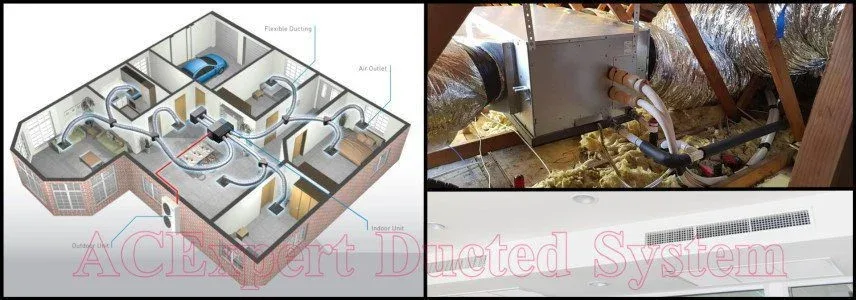
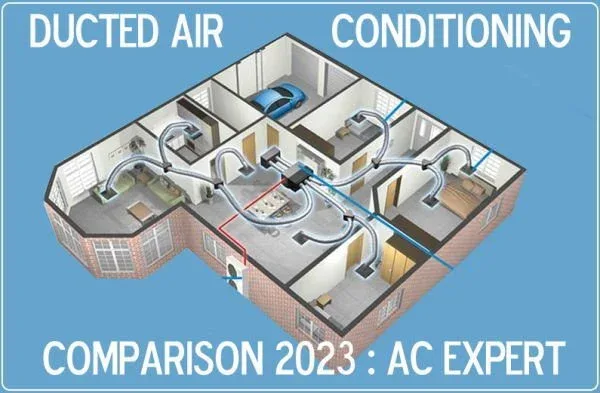
VARIOUS DUCTED AIR CON SYSTEMS INSTALLED IN A HOME
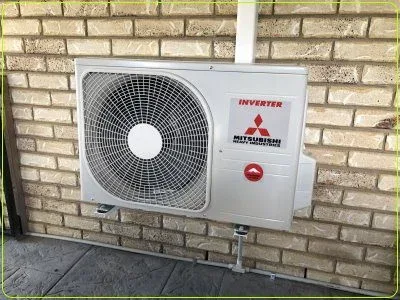
SPLIT SYSTEM
Ducted Air Con vs Split Systems: The Brutal Truth About Your Electricity Bill
Let’s be honest for a second. When you walk into a display home, or you’re watching one of those renovation shows where the couple has a budget of three million dollars and somehow still complains about the tile choice, you see ducted air con. It’s slick. It’s invisible. It screams “I have made it in life.”
For decades, ducted air conditioning has been the gold standard for Australian homes. It was the heavy-weight champion, the big kahuna, the only way to cool a sprawling house in the middle of a scorching January heatwave. And for a long time, split systems were the ugly cousins—those noisy, boxy things that hung on the wall like a plastic growth.
Air Conditioning expert need not introduce split system air conditioning onto this page. To get here the reader must have come through a whole network of pages detailing split system costs, efficiency and sizing. However this is our page to examine Ducted Air Conditioning under the microscope, and see how it stacks up next to Splits.
INSTALLATION COST FOR DUCTED AIRCONDITIONING VS SPLIT SYSTEM
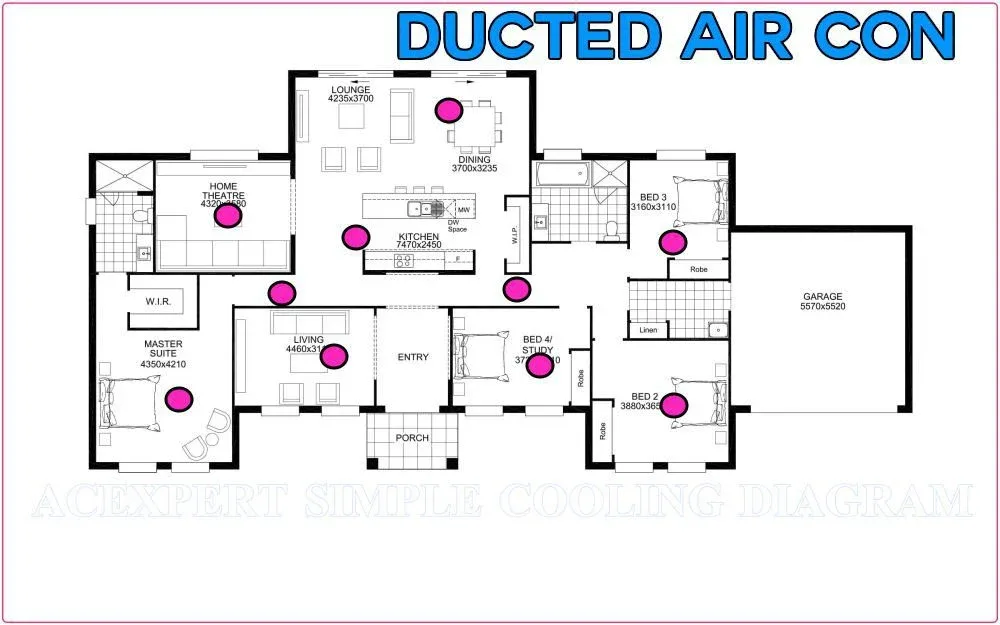
14 KW SYSTEM 10 OUTLETS IN A 4 BEDROOM HOUSE
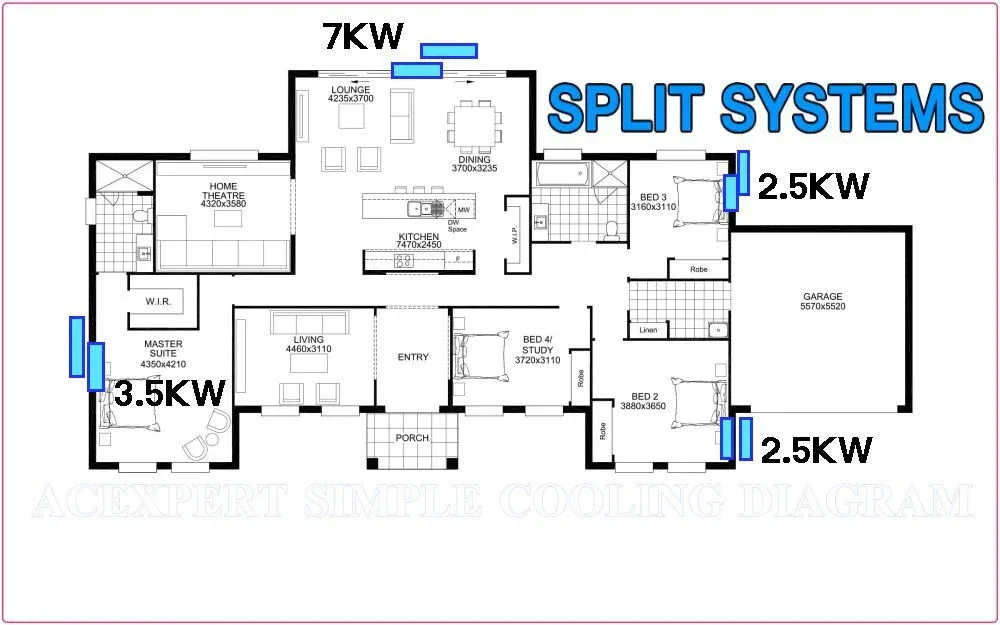
4 SPLIT SYSTEMS 3 X BEDROOMS + 7KW MAIN AREA
COOLING DIAGRAM + COSTS FOR DUCTED AIR
COOLING DIAGRAM + COSTS FOR SPLIT SYSTEMS
DUCTED INSTALLATION COSTS AND COOLING EFFECT
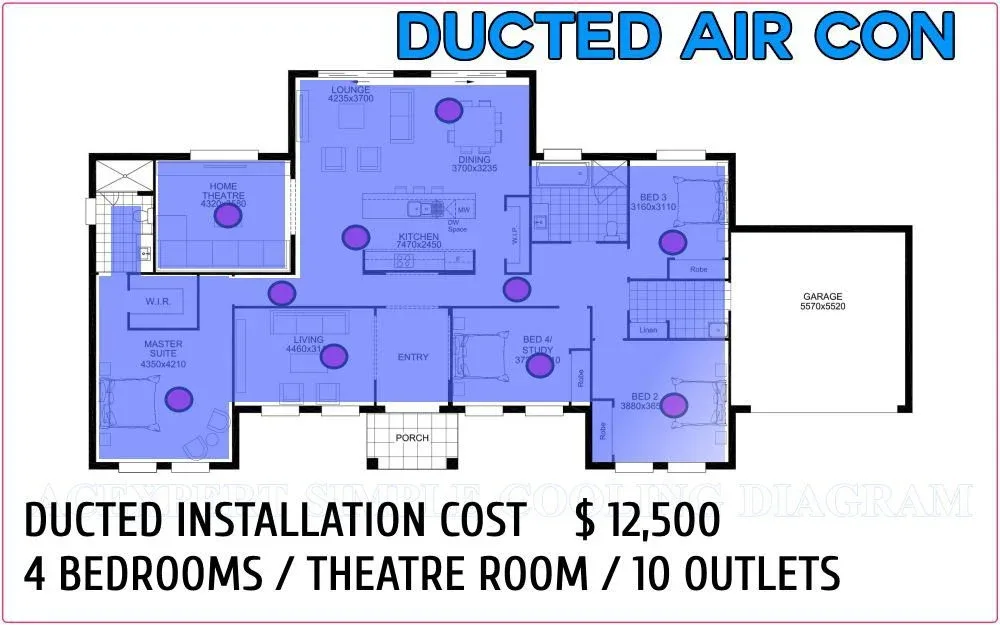
We can see from the above diagram that the ducted system cools thew house more evenly than the split systems. There are ten outlets in the ceiling and this equates to about 14kw of cooling capacity in the main units. The installation would take 3 men a full day to complete, though this would usually be done at frame stage during construction. The most important question for most readers is the cost difference. Is it worth an extra $5000 up front to have those hallways and peripheral areas cooled to the exact temperature of the lounge? Are you running a hospital or infirmary where the temperature needs to be so tightly controlled? Are you aware that the running costs for the ducted are around double that of the splits on the opposite side? These are questions that need to be addressed before you outlay $12,500.
SPLIT SYSTEM INSTALLATION COSTS AND COOLING
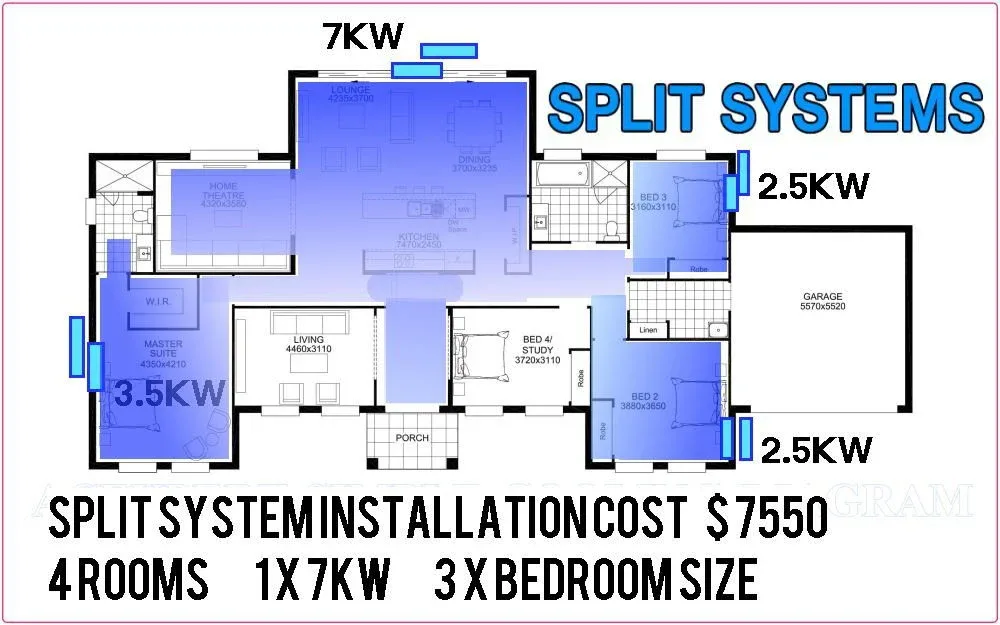
What do we notice about the above diagram when we compare it to the ducted air conditioning diagram on the left? Overall, the house is cooled to the same temperature. The split systems don’t cool the home as evenly as the ducted, but all the main areas you live in are just as cool. There’s not as many ceiling outlets. There are 4 head units on various walls around the home. The differences aren’t that noticeable until it comes to price. This same identical house, cooled to the same temperature, on the same hot day of summer has cost you $5000 less than a ducted air conditioning system. The same end result and you still have 5k?
But wait till you see the running cost comparison. It gets even better.
HOW DO THE TWO SYSTEMS COMPARE?
DUCTED AIR CON vs SPLIT SYSTEM RUNNING COSTS
DUCTED AIR CONDITIONER WILL SEND YOU BROKE.
Ducted systems cost a lot more to run than split systems. How much more? According to other industry professionals 3 – 4 x as much to run. That’s a per square metre comparison! According to Ergon energy, running your ducted just 4 hours per day will add $1662 to your annual power bill. In a Queensland summer, the air con must run all night just so you can sleep. When you add even part of the day, those costs are astronomical.
One customer reported his power bill going from11kw/h per day to 44kw/h per day after the install of his ducted air conditioner. These are no isolated incidents. According to an energy watch website, the main cause of abnormally high power bills is ducted air conditioning. Once that bill comes in there’s no disputing it. There’s no refunding your outlay, you’re stuck with that ducted air conditioning system – and its associated costs – for the life of that unit.
ZONING OFF THE DUCTED AIR CON TO SAVE MONEY
Some ducted air conditioning salesman will tell you that you can cut those costs by zoning your system to cool only certain areas. That’s true, but to cool two rooms you are still running your 14kw condenser. When you move into a new home do you even know how to zone the air con? Most people turn it on or off – that’s all we know how to do.
SPLIT SYSTEM RUNNING COSTS = FRACTION OF DUCTED
DUCTED AIR CONDITIONING REPAIRS COST YOU MONEY
The reason AC Expert knows how much more efficient splits are than ducted air conditioning is because I moved into a home in Stretton in 2017 which had a ducted installed. I ran it sparingly from September through to December and got my first $1000+ power bill. I was shocked. Air Conditioning Installation was my line of work so I put in 3 splits straight away, and ran them all through the summer.
The house was just as cool, if not cooler. I ran the 7kw and 5kw Mitsubishi all day every day – and kept the bedroom one off until night time. I ran the bedroom one 7 nights a week from 9pm to 5am and when the next bill came in March – it was down to just over $400. We run a home office from there, and all the usual appliances. The bill hasn’t climbed past $450 for a quarter since then.
I will never install a ducted air conditioning system now I know how much they cost to run, and I advise you to do the same.
SPLIT SYSTEMS – THE MOST EFFICIENT APPLIANCES
A typical Australian home on a hot summer night – only the master and one other bedroom are occupied. It’s January in Queensland so the air con must be on to get any sleep. If you had two splits installed you’re only running 2.5kw each as opposed to the14kw ducted all night, every night. Then during the day, the bedroom splits go off and the living room ones go on. You’re still in front.
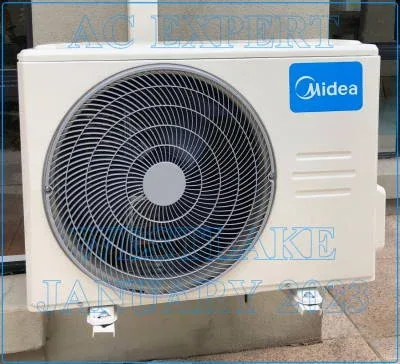
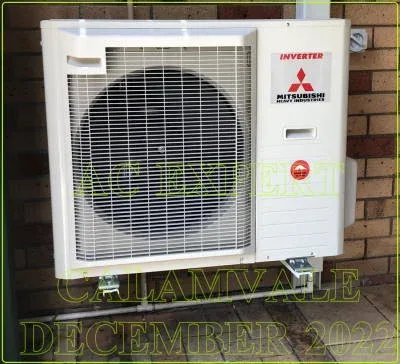
But times have changed. Technology has moved on. And if you are still looking at installing ducted air con in 2025, you might as well be looking for a place to park your horse and cart.
We aren’t here to sell you the dream of invisible vents. We are here to save your wallet from a world of hurt. We have put ducted air conditioning under the microscope, compared it to modern split systems, and the results are about as one-sided as a footy match where the referee has been paid off.
Here is why ducted systems are essentially dinosaur tech, and why the smart money—the money that likes to stay in your bank account—is moving to splits.
The Installation Sting: Why Pay More for the Same Cold Air?
Let’s talk brass tacks. You want your house cool. You don’t want to sweat through your sheets at 2:00 AM. That is the goal. The question is, how much of a premium are you willing to pay for that privilege?
If we look at a standard setup for a decent-sized Aussie family home—say, a 4-bedroom place with a lounge and a media room—the price difference is enough to make you choke on your meat pie.
To install a 14kW ducted air con system with 10 outlets, you are looking at a messy installation process. If you aren’t building from scratch, this involves men crawling through your roof cavity, cutting massive holes in your plasterboard, and running flexible ducting that looks like a giant silver worm farm through your trusses. The cost? You are looking at around $12,500 upfront.
Now, compare that to the split system alternative.
To cool that exact same house, you would likely install four high-quality split systems. You’d put a big 7kW unit in the main living area to handle the heavy lifting, and three 2.5kW units in the bedrooms. The result? Every main area of the house is freezing cold. The cost? Roughly $7,500.
That is a $5,000 difference right out of the gate.
Think about that. Five grand. That isn’t loose change you find down the back of the sofa. That is a decent family holiday to Bali. That is a second-hand Corolla for the teenager. That is a lot of cases of beer. Are you really going to hand over an extra $5,000 just so you don’t have to see a white box on the wall? Unless you are running a museum or trying to impress a mother-in-law who is never going to like you anyway, the math just doesn’t add up.
The Cooling Myth: Do You Live in a Hospital?
The biggest selling point for ducted air con is “even cooling.” Salesmen love this phrase. They will tell you that a ducted system ensures that every square inch of your home is the exact same temperature, from the lounge room to the laundry, to the hallway that leads to the spare toilet.
But ask yourself this: Do you actually live in your hallway?
Unless you are running a hospital or an infirmary where delicate patients need a strictly controlled environment while they walk from the bedroom to the kitchen, you do not need the entire volume of your house cooled simultaneously.
When you turn on a ducted system, you are often pressurizing and cooling vast amounts of dead space. You are paying to cool the air above the dining table at 3:00 AM. You are paying to cool the walk-in robe. It is incredibly inefficient.
With a split system setup, the cooling is slightly less “even” throughout the passageways, sure. Walking from a freezing cold bedroom to a freezing cold lounge room might involve three seconds of walking through a slightly warmer hallway. Is that three-second journey worth the $5,000 installation premium? We don’t think so.
Running Costs: The Silent Wallet Killer
This is where the ducted air con salesman usually stops talking and starts shuffling his papers. The installation cost is painful, but the running costs are terminal.
Ducted systems are notoriously power-hungry. We aren’t talking a little bit more expensive; we are talking astronomical. Industry professionals and energy audits consistently show that ducted systems can cost three to four times as much to run as split systems.
According to data from Ergon Energy, running a standard ducted system for just four hours a day can add over $1,600 to your annual power bill. And let’s be real—who in Queensland runs the air con for only four hours in January? You turn that thing on in November and you don’t touch the off button until Easter.
We have seen customer reports of power bills jumping from a manageable 11kWh per day usage to a staggering 44kWh per day immediately after a ducted install.
Once that bill arrives, there is no return policy. You can’t ring up the power company and say, “Oh, sorry mate, I didn’t realise the big silver box in the roof drank electricity like it was water.” You are stuck with it. You have effectively married a partner with a gambling addiction; they are going to drain your funds for the lifespan of the unit, and there is nothing you can do about it except sit in the dark and sweat.
A Personal Horror Story: The Stretton Experience
You don’t just have to take the technical specs for it. We live this. The founder of Air Conditioning Expert moved into a home in Stretton back in 2017. The house came with a ducted air con system already installed. “Jackpot,” he thought. “Luxury living.”
He ran it sparingly—just the basics—from September through December. When the first quarterly bill arrived, it was over $1,000. For a standard home.
Being in the industry, he knew exactly what the culprit was. He didn’t mess around. He immediately installed three separate split systems and stopped using the ducted unit entirely. He ran the new splits hard. The big 7kW unit ran all day in the office/lounge, and the bedroom units ran all night, seven nights a week, so the family could sleep.
The result? The next bill dropped to just over $400.
That is a 60% reduction in running costs, despite running the air conditioning more often. Over the course of five years, that is a saving of roughly $12,000. Add that to the installation savings, and you are starting to see why we argue against ducted so passionately. It’s not just preference; it’s financial survival.
The Zoning Fallacy: Why Turning Off Rooms Doesn’t Fix It
“But wait!” I hear you cry. “My ducted system has zones! I can turn off the spare rooms!”
This is the lifeboat that ducted salesmen try to sell you. They claim that by “zoning” off the unused rooms, you save money. While this is technically true compared to cooling the whole house, it is still wildly inefficient compared to splits.
Here is the physics problem: You still have a massive 14kW or 16kW compressor sitting outside your house. That is a V8 engine. Even if you only want to cool one bedroom, you are turning on that V8 engine to do it.
Sure, modern inverters can ramp down, but they can only ramp down so far. You are still circulating refrigerant through a massive system, losing energy through the ductwork in the hot roof cavity, and running a large fan motor to push air down long tubes.
Compare that to a 2.5kW split system in a bedroom. That is a 4-cylinder hatchback engine. It is designed to cool a small space efficiently. When you turn it on, it sips power. When you turn on a zoned ducted system to cool one room, it’s like using a chainsaw to cut a block of cheese. It works, but it’s messy and wasteful.
Furthermore, let’s be honest about “zoning.” When you move into a new house, do you really learn how to program the interface? Most ducted control panels look like the cockpit of a space shuttle. Nobody knows how to use them. You press “On,” you set it to “Arctic,” and you hope for the best.
The Night Shift: Where Splits Win the Championship
The biggest victory for split systems happens at night. This is the scenario that plays out in almost every Australian home.
It is 10:00 PM. The kids are asleep. You are in bed. The lounge room, kitchen, dining room, and media room are all empty.
If you have ducted air con, you are running the big central unit just to keep the master bedroom cool. Even if you zone it down, that big outdoor unit is humming away, burning cash.
If you have splits, you turn off the living area unit. You turn on the small, whisper-quiet 2.5kW unit in your bedroom. It cools the room in five minutes, then the inverter drops down to a low-power maintenance mode. It effectively runs on the smell of an oily rag for the rest of the night.
You sleep like a baby, and you don’t wake up screaming when the Ergon bill arrives.
Maintenance and The Nightmare of the Single Point of Failure
Finally, let’s talk about what happens when things go wrong. And they will go wrong, usually on Christmas Day when it is 38 degrees and the relatives are over.
If you have a ducted system, you have a single point of failure. If the compressor blows, or a rat chews through a main control wire, or the fan motor seizes, you lose everything. The whole house goes down. You are effectively living in a sauna until the repair guy can come out (which will be in three weeks because everyone else’s air con is broken too).
Now, imagine that same scenario with split systems.
You have four separate units. Four separate condensers. Four separate fans. If the unit in the lounge room dies, it’s annoying, sure. But guess what? The bedrooms still work. You can retreat to the bedroom, watch Netflix, and stay cool. You have built-in redundancy. You haven’t put all your eggs in one expensive, power-hungry basket.
Also, have you ever tried to clean the inside of a duct? You can’t. Over ten years, those silver tubes in your ceiling fill up with dust, dead skin, bug parts, and whatever else is floating around. You are breathing that in. With a split system, you pop the front, pull out the filter, wash it in the sink, and you’re done. Clean air, zero cost.
The Verdict
Look, we get it. Ducted air con looks nice. It feels fancy. But the numbers simply do not stack up.
In 2025, split systems are powerful, efficient, quiet, and cheap. They have rendered the old ducted behemoths obsolete.
Why pay 30% more to buy the system?
Why pay 300% more to run the system?
Why risk losing all your cooling if one part breaks?
Don’t let vanity dictate your comfort. Keep the $5,000 in your pocket, save thousands on your bills over the next few years, and buy a split system. Your bank account will thank you, and frankly, nobody cares about the white box on your wall if the beer is cold and the room is comfortable.

REBATES

SIZING

AC REVIEWS

PRICES

AC SOUND

QUOTE

BUDGET AC

INSTALLS
中國人

DUCTED

EFFICIENCY

CONTACT

DUCTED AIR CON
VS
SPLIT SYSTEMS
Ducted Air Con vs Split Systems: The Brutal Truth About Your Electricity Bill
Let’s be honest for a second. When you walk into a display home, or you’re watching one of those renovation shows where the couple has a budget of three million dollars and somehow still complains about the tile choice, you see ducted air con. It’s slick. It’s invisible. It screams “I have made it in life.”
For decades, ducted air conditioning has been the gold standard for Australian homes. It was the heavy-weight champion, the big kahuna, the only way to cool a sprawling house in the middle of a scorching January heatwave. And for a long time, split systems were the ugly cousins—those noisy, boxy things that hung on the wall like a plastic growth.
But times have changed. Technology has moved on. And if you are still looking at installing ducted air con in 2025, you might as well be looking for a place to park your horse and cart.

We aren’t here to sell you the dream of invisible vents. We are here to save your wallet from a world of hurt. We have put ducted air conditioning under the microscope, compared it to modern split systems, and the results are about as one-sided as a footy match where the referee has been paid off.
Here is why ducted systems are essentially dinosaur tech, and why the smart money—the money that likes to stay in your bank account—is moving to splits.
The Installation Sting: Why Pay More for the Same Cold Air?
Let’s talk brass tacks. You want your house cool. You don’t want to sweat through your sheets at 2:00 AM. That is the goal. The question is, how much of a premium are you willing to pay for that privilege?
If we look at a standard setup for a decent-sized Aussie family home—say, a 4-bedroom place with a lounge and a media room—the price difference is enough to make you choke on your meat pie.
To install a 14kW ducted air con system with 10 outlets, you are looking at a messy installation process. If you aren’t building from scratch, this involves men crawling through your roof cavity, cutting massive holes in your plasterboard, and running flexible ducting that looks like a giant silver worm farm through your trusses. The cost? You are looking at around $12,500 upfront.
Now, compare that to the split system alternative.
To cool that exact same house, you would likely install four high-quality split systems. You’d put a big 7kW unit in the main living area to handle the heavy lifting, and three 2.5kW units in the bedrooms. The result? Every main area of the house is freezing cold. The cost? Roughly $7,500.
SPLIT SYSTEM COMES ALONG
That is a $5,000 difference right out of the gate.
Think about that. Five grand. That isn’t loose change you find down the back of the sofa. That is a decent family holiday to Bali. That is a second-hand Corolla for the teenager. That is a lot of cases of beer. Are you really going to hand over an extra $5,000 just so you don’t have to see a white box on the wall? Unless you are running a museum or trying to impress a mother-in-law who is never going to like you anyway, the math just doesn’t add up.
The Cooling Myth: Do You Live in a Hospital?
The biggest selling point for ducted air con is “even cooling.” Salesmen love this phrase. They will tell you that a ducted system ensures that every square inch of your home is the exact same temperature, from the lounge room to the laundry, to the hallway that leads to the spare toilet.
But ask yourself this: Do you actually live in your hallway?
Unless you are running a hospital or an infirmary where delicate patients need a strictly controlled environment while they walk from the bedroom to the kitchen, you do not need the entire volume of your house cooled simultaneously.
When you turn on a ducted system, you are often pressurizing and cooling vast amounts of dead space. You are paying to cool the air above the dining table at 3:00 AM. You are paying to cool the walk-in robe. It is incredibly inefficient.
With a split system setup, the cooling is slightly less “even” throughout the passageways, sure. Walking from a freezing cold bedroom to a freezing cold lounge room might involve three seconds of walking through a slightly warmer hallway. Is that three-second journey worth the $5,000 installation premium? We don’t think so.
Running Costs: The Silent Wallet Killer
This is where the ducted air con salesman usually stops talking and starts shuffling his papers. The installation cost is painful, but the running costs are terminal.
Ducted systems are notoriously power-hungry. We aren’t talking a little bit more expensive; we are talking astronomical. Industry professionals and energy audits consistently show that ducted systems can cost three to four times as much to run as split systems.
According to data from Ergon Energy, running a standard ducted system for just four hours a day can add over $1,600 to your annual power bill. And let’s be real—who in Queensland runs the air con for only four hours in January? You turn that thing on in November and you don’t touch the off button until Easter.
We have seen customer reports of power bills jumping from a manageable 11kWh per day usage to a staggering 44kWh per day immediately after a ducted install.
Once that bill arrives, there is no return policy. You can’t ring up the power company and say, “Oh, sorry mate, I didn’t realise the big silver box in the roof drank electricity like it was water.” You are stuck with it. You have effectively married a partner with a gambling addiction; they are going to drain your funds for the lifespan of the unit, and there is nothing you can do about it except sit in the dark and sweat.
A Personal Horror Story: The Stretton Experience
You don’t just have to take the technical specs for it. We live this. The founder of Air Conditioning Expert moved into a home in Stretton back in 2017. The house came with a ducted air con system already installed. “Jackpot,” he thought. “Luxury living.”
He ran it sparingly—just the basics—from September through December. When the first quarterly bill arrived, it was over $1,000. For a standard home.
Being in the industry, he knew exactly what the culprit was. He didn’t mess around. He immediately installed three separate split systems and stopped using the ducted unit entirely. He ran the new splits hard. The big 7kW unit ran all day in the office/lounge, and the bedroom units ran all night, seven nights a week, so the family could sleep.
The result? The next bill dropped to just over $400.
That is a 60% reduction in running costs, despite running the air conditioning more often. Over the course of five years, that is a saving of roughly $12,000. Add that to the installation savings, and you are starting to see why we argue against ducted so passionately. It’s not just preference; it’s financial survival.
The Zoning Fallacy: Why Turning Off Rooms Doesn’t Fix It
“But wait!” I hear you cry. “My ducted system has zones! I can turn off the spare rooms!”
This is the lifeboat that ducted salesmen try to sell you. They claim that by “zoning” off the unused rooms, you save money. While this is technically true compared to cooling the whole house, it is still wildly inefficient compared to splits.
Here is the physics problem: You still have a massive 14kW or 16kW compressor sitting outside your house. That is a V8 engine. Even if you only want to cool one bedroom, you are turning on that V8 engine to do it.
Sure, modern inverters can ramp down, but they can only ramp down so far. You are still circulating refrigerant through a massive system, losing energy through the ductwork in the hot roof cavity, and running a large fan motor to push air down long tubes.
DUCTED AIR CON
4 BEDROOM HOUSE
TEN OUTLETS
We can see from the diagram that the ducted air conditioning system cools the house evenly. There are ten outlets in the ceiling and this equates to14kw of cooling capacity. The installation would take 3 men a full day to complete, though this would usually be done at frame stage during construction. The whole thing costs about $12,500 installed complete. Now please take a look at the same house with split systems installed.
SPLIT SYSTEMS
SAME HOUSE
What do we notice about the diagram when we compare it to the ducted air conditioning one above? Overall, the house is cooled to the same level. The split systems don’t cool the home as evenly as the ducted, but all the main areas are at the same temperature. There are 4 head units on various walls around the home. The differences aren’t noticeable until it comes to price.
You can see the same identical house above, cooled to the same temperature, on the same hot day of summer has cost you $5000 less than a ducted air conditioning system.
THE TOUGHEST QUESTIONS
Is it worth an extra $5000 to have those hallways and peripheral areas cooled to the exact temperature of the lounge? Are you running a hospital or infirmary where the temperature needs to be so tightly controlled? Are you aware that the running costs for the ducted are around double that of the splits on the opposite side? These are questions that need to be addressed before you outlay $12,500.
But wait till you see the running cost comparison. It gets even better.
DUCTED AIR CON
RUNNING COSTS
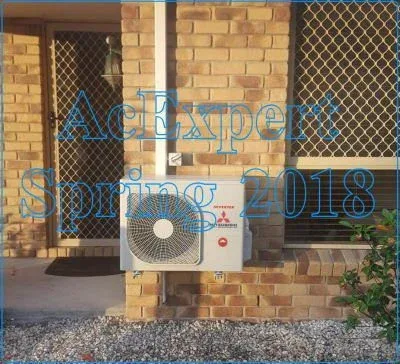
Ducted systems cost a lot more to run than split systems. How much more? According to other industry professionals 3 – 4 x as much to run. That’s a per square metre comparison! According to Ergon energy, running your ducted just 4 hours per day will add $1662 to your annual power bill. In a Queensland summer, the air con must run all night just so you can sleep. When you add even part of the day, those costs are astronomical.
One customer reported his power bill going from11kw/h per day to 44kw/h per day after the install of his ducted air conditioner. These are no isolated incidents. According to an energy watch website, the main cause of abnormally high power bills is ducted air conditioning. Once that bill comes in there’s no disputing it. There’s no refunding your outlay, you’re stuck with that ducted air conditioning system – and its associated costs – for the life of that unit.
ZONING OFF THE DUCTED AIR CON TO SAVE MONEY
Compare that to a 2.5kW split system in a bedroom. That is a 4-cylinder hatchback engine. It is designed to cool a small space efficiently. When you turn it on, it sips power. When you turn on a zoned ducted system to cool one room, it’s like using a chainsaw to cut a block of cheese. It works, but it’s messy and wasteful.
Furthermore, let’s be honest about “zoning.” When you move into a new house, do you really learn how to program the interface? Most ducted control panels look like the cockpit of a space shuttle. Nobody knows how to use them. You press “On,” you set it to “Arctic,” and you hope for the best.
The Night Shift: Where Splits Win the Championship
The biggest victory for split systems happens at night. This is the scenario that plays out in almost every Australian home.
It is 10:00 PM. The kids are asleep. You are in bed. The lounge room, kitchen, dining room, and media room are all empty.
If you have ducted air con, you are running the big central unit just to keep the master bedroom cool. Even if you zone it down, that big outdoor unit is humming away, burning cash.
If you have splits, you turn off the living area unit. You turn on the small, whisper-quiet 2.5kW unit in your bedroom. It cools the room in five minutes, then the inverter drops down to a low-power maintenance mode. It effectively runs on the smell of an oily rag for the rest of the night.
You sleep like a baby, and you don’t wake up screaming when the Ergon bill arrives.
Maintenance and The Nightmare of the Single Point of Failure
DUCTED AIR CON REPAIRS
Finally, let’s talk about what happens when things go wrong. And they will go wrong, usually on Christmas Day when it is 38 degrees and the relatives are over.
If you have a ducted system, you have a single point of failure. If the compressor blows, or a rat chews through a main control wire, or the fan motor seizes, you lose everything. The whole house goes down. You are effectively living in a sauna until the repair guy can come out (which will be in three weeks because everyone else’s air con is broken too).
As if the case for split systems wasn’t already strong enough, the final thought must go to the maintenance and upkeep on the ducted. What if something goes wrong with your condenser? Maybe the evaporator? Anything at all. You lose all your air conditioning.
Now imagine something going wrong with one of your split systems. You still have three more. Your house will be mostly cool, you can live in the parts that are if you have to. You won’t lose all your air conditioning because your splits are sharing the load.
Now, imagine that same scenario with split systems.
You have four separate units. Four separate condensers. Four separate fans. If the unit in the lounge room dies, it’s annoying, sure. But guess what? The bedrooms still work. You can retreat to the bedroom, watch Netflix, and stay cool. You have built-in redundancy. You haven’t put all your eggs in one expensive, power-hungry basket.
Also, have you ever tried to clean the inside of a duct? You can’t. Over ten years, those silver tubes in your ceiling fill up with dust, dead skin, bug parts, and whatever else is floating around. You are breathing that in. With a split system, you pop the front, pull out the filter, wash it in the sink, and you’re done. Clean air, zero cost.
DUCTED AIR CON vs SPLITS?
The Verdict
Look, we get it. Ducted air con looks nice. It feels fancy. But the numbers simply do not stack up.
In 2025, split systems are powerful, efficient, quiet, and cheap. They have rendered the old ducted behemoths obsolete.
Why pay 30% more to buy the system?
Why pay 300% more to run the system?
Why risk losing all your cooling if one part breaks?
Don’t let vanity dictate your comfort. Keep the $5,000 in your pocket, save thousands on your bills over the next few years, and buy a split system. Your bank account will thank you, and frankly, nobody cares about the white box on your wall if the beer is cold and the room is comfortable.

PRICES

DUCTED

SIZING

QUOTE
PLACE

BUDGET AC
EFFICIENCY
SMALLEST
BRANDS
BOOKING